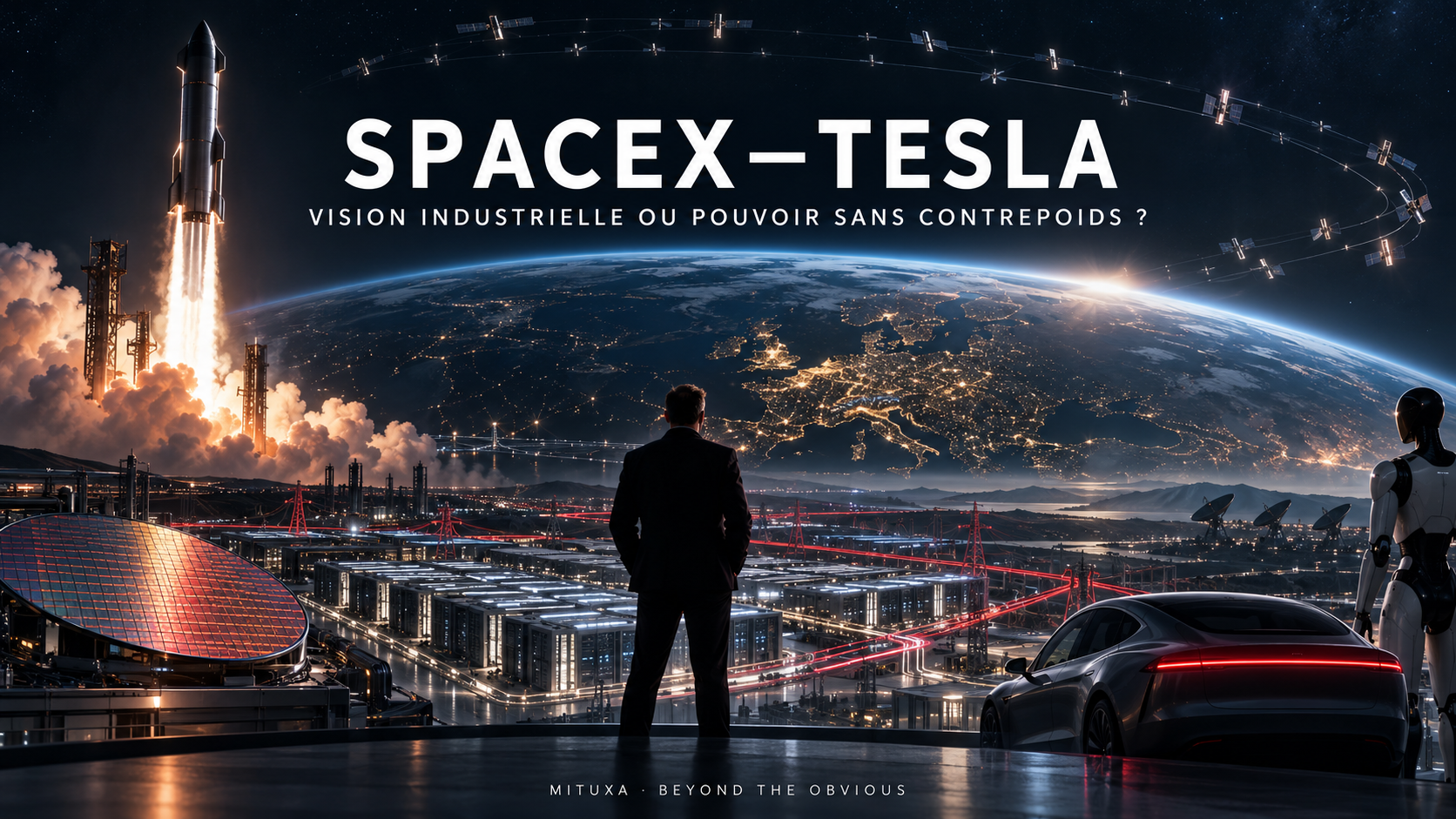
SpaceX and Tesla are no longer merely occasional partners. The two companies are developing Terafab, a joint project intended to secure access to semiconductors and computing capacity. Their boards have also formed independent committees to evaluate a possible combination.
Facts must nevertheless be separated from narrative. Terafab exists as a framework for collaboration. A merger remains only a possibility: no agreement, exchange ratio or formal recommendation has been announced.
The investment question is therefore not whether Elon Musk can build a spectacular conglomerate. It is whether integrating energy, chips, artificial intelligence, connectivity, robotics and space would create more economic value than keeping the two companies separate.
A second, more uncomfortable question must also be asked. What happens when one executive can simultaneously influence access to information, military communications, computing capacity, autonomous mobility, energy and space? A merger would not merely create an industrial champion. It could move Elon Musk closer to the status of a private sovereign, controlling infrastructure normally distributed across several companies and public institutions.
1. What is confirmed — and what is not
Reported
SpaceX and Tesla announced a collaboration in March 2026 to develop Terafab. The project ultimately aims to produce the equivalent of one terawatt of computing hardware per year. Elon Musk said the first experimental SRAM circuit could be produced in May or June 2027, with volume production targeted for the third quarter of 2028.
SpaceX subsequently confirmed in its quarterly report that its board and Tesla's board had each formed a special committee to evaluate a potential combination. The filing states that no decision has been made and no transaction is guaranteed.
Not confirmed
- No definitive merger agreement.
- No officially agreed transaction valuation.
- No exchange ratio.
- No voting timetable.
- No regulatory commitment.
- No guarantee that either committee will recommend a transaction.
MITUXA View: the market may confuse three very different levels: a real supplier–customer relationship, an industrial joint venture under development and a full merger that remains hypothetical. Their value, risks and capital requirements should not be added together as if they already formed a single company.
2. SpaceX is no longer only a space company
Following the integration of xAI, SpaceX reports three segments:
- Space — Falcon, Dragon, Starship, and commercial and government launches.
- Connectivity — Starlink, Starshield, terminals and satellite services.
- SI — Grok, X, Cursor, advertising, subscriptions, APIs and computing-capacity rental.
The transformation was striking in the third quarter of 2026.
| Q3 2026 | Revenue | Operating income | Capex |
|---|---|---|---|
| Space | $1.767bn | -$0.007bn | $1.606bn |
| Connectivity | $5.248bn | $2.367bn | $1.543bn |
| SI | $7.560bn | $0.431bn | $16.444bn |
| Group | $14.575bn | $2.791bn | $19.593bn |
The original launch business accounted for only 12% of quarterly revenue. Starlink is the principal operating engine, while SI has become the largest source of revenue — and absorbs most of the investment.
This distinction matters. SpaceX reported quarterly net income of $4.404 billion and adjusted EBITDA of $8.809 billion. Over nine months, however, the group remained at a net loss of $413 million and spent almost $40 billion on capital expenditure.
Part of the quarterly profit also came from items below operating income, including financial income and valuation gains. The underlying economics were therefore less spectacular than quarterly net income alone suggests.
3. The economic engine: Starlink finances optionality
SpaceX's current strength is not simply launching rockets. It uses an integrated launch infrastructure to deploy its own assets at a cost and pace that are difficult to reproduce.
- More launches reduce unit costs.
- Lower costs accelerate Starlink deployment.
- A denser constellation improves service and expands the addressable market.
- Subscriptions fund satellites, Starship and new infrastructure.
- Orbital capacity can then support military communications and, potentially, space-based computing.
Connectivity generated $2.367 billion of operating income on $5.248 billion of revenue in Q3. Space was close to break-even despite the investment in Starship. Over the first nine months, however, Space lost $1.211 billion and SI lost $3.295 billion, while Connectivity earned $5.211 billion.
Key takeaway: Starlink is currently the financial bridge between businesses that already make money and the group's most ambitious bets.
4. What Tesla really contributes
Tesla would contribute more than market capitalisation or a brand. It owns several industrial capabilities that could be useful to the ecosystem:
- large-scale manufacturing capacity;
- energy-storage systems;
- expertise in power electronics and cooling;
- a vehicle-generated data platform;
- Robotaxi, FSD and Optimus as future consumers of computing power;
- a global supply chain and a culture of vertical integration.
In Q3, Tesla generated $28.046 billion of revenue, $718 million of operating income and $1.531 billion of free cash flow. Cash and short-term investments totalled $45.447 billion.
The contrast with its valuation remains pronounced. Market capitalisation exceeded $1.3 trillion while quarterly operating margin was only about 2.6%. Tesla's value therefore depends much less on today's automotive business than on the future success of autonomy, robotics, energy and AI.
5. The collaboration already exists
The economic links between the two groups are not theoretical.
Tesla invested $2 billion in SpaceX in March 2026. The stake, below 1%, was worth $2.865 billion at 30 September. Tesla also recognised $221 million of Q3 revenue from Megapack sales to SpaceX. Remaining unsatisfied performance obligations connected with these contracts totalled $648 million.
This reveals the ecosystem's logic: SpaceX and xAI data centres need electricity and storage; Tesla has products that can meet that demand quickly; both companies then want to secure the chips required by their models and autonomous machines.
6. Terafab: the central piece
Terafab aims to reduce dependence on external foundries and memory suppliers by bringing together design, manufacturing, memory, advanced packaging and testing.
The reasoning is understandable. If SpaceX, xAI and Tesla consume growing quantities of semiconductors, their combined demand could justify dedicated infrastructure and allow hardware, models and applications to be optimised together.
But manufacturing leading-edge semiconductors is not a natural extension of automotive or space production. The obstacles include:
- tens of billions of dollars of investment before meaningful scale;
- low initial manufacturing yields;
- dependence on lithography equipment and specialised materials;
- continuous technological competition;
- the risk that computing architectures evolve before factories are depreciated;
- the need for very high volumes to achieve competitive costs.
MITUXA View: Terafab could become a strategic advantage without becoming the lowest-cost foundry. Its value may lie in security of supply, co-design and iteration speed. A strategically important factory can nevertheless be economically mediocre. Technological independence does not guarantee a high return on capital.
7. The Obvious: an integrated technology empire
The optimistic case rests on an almost complete integration of the physical-AI value chain.
- Tesla Energy supplies electricity and storage. Megapacks can power and stabilise data-centre infrastructure.
- Terafab turns that energy into computing capacity. The project seeks to secure the chips, memory and advanced packaging required by the group's businesses.
- xAI uses that infrastructure to train and operate its models. Grok and computing services become the intelligence layer.
- Tesla deploys that intelligence in the physical world. Robotaxi, FSD and Optimus become applications capable of perceiving, deciding and acting.
- SpaceX provides connectivity and geographic expansion. Starlink distributes data and services, while launches open the possibility of new orbital infrastructure.
- Users and machines generate new data. Those data can improve the models, products and efficiency of the system.
A combined entity could therefore control energy, semiconductors, data centres, AI models, communications, autonomous vehicles, robots and access to space.
Integration could accelerate decisions, pool engineers, reduce negotiations between related companies and direct capital more quickly towards projects considered most important.
The Obvious: bringing all these building blocks under one direction could create an execution speed that fragmented competitors would struggle to reproduce.
8. Beyond the Obvious: capital allocation matters more than technology
Technology is not the principal constraint. The decisive issue is the capital required to develop all of the following at the same time:
- Starship and launch infrastructure;
- new generations of satellites;
- data centres and computing capacity;
- Terafab;
- Robotaxi;
- Optimus;
- battery and Megapack capacity.
At the end of September, SpaceX held about $89.9 billion of cash and marketable securities, strengthened substantially by the IPO and debt issuance. Yet Q3 investment reached $19.6 billion, including $16.4 billion in SI.
Tesla committed $13 billion of capex in the first nine months of 2026, compared with $6.1 billion a year earlier. It remains cash-generative, but must also finance several projects before they reach meaningful profitability.
A merger would not eliminate these capital needs. It would move allocation decisions into one structure — offering more flexibility but less transparency between activities.
9. Plausible synergies
Industrial synergies
- Megapacks for SpaceX and xAI computing centres;
- shared power-electronics, cooling and industrial-engineering expertise;
- aggregated orders for components and semiconductors;
- faster manufacturing through Gigafactory experience;
- joint optimisation across chips, models and autonomous devices.
Strategic synergies
- Starlink as a connectivity layer for vehicles and robots;
- distributed data from Tesla and X platforms;
- launches of dedicated computing or observation constellations;
- integrated access to civil, commercial and government markets.
Financial synergies
- a larger pool of capital;
- greater capacity to finance very long-duration investments;
- allocation between mature businesses and loss-making projects.
The last category is also the most dangerous. What management describes as flexible allocation may look to shareholders like cross-subsidisation that cannot be controlled.
10. The economic conflicts
The two companies do not have the same profile. SpaceX combines sensitive government contracts, satellite infrastructure, artificial intelligence and very heavy investment. Tesla is more dependent on consumers, has significant operations in China and remains exposed to automotive regulation.
A merger could therefore:
- complicate security clearances linked to military activity;
- expose Tesla's Chinese operations to geopolitical tensions;
- increase antitrust and foreign-investment scrutiny;
- make the accounts harder to understand;
- concentrate more voting power around Elon Musk;
- create disputes over capital allocation between shareholder groups.
The principal potential conflict concerns the exchange ratio. With market values of about $2.0 trillion for SpaceX and $1.318 trillion for Tesla on 23 October, a combination without premium or discount would allocate roughly 60% of the entity to SpaceX shareholders and 40% to Tesla shareholders, before adjustments for existing holdings and different share classes.
This arithmetic is not a transaction proposal. It simply shows why a few valuation points could transfer tens of billions of dollars from one shareholder group to the other.
11. From visionary to private sovereign: the Musk risk
Calling Elon Musk a “tyrant” as if it were an established fact would be excessive. Ignoring the risk of authoritarian drift in a structure this concentrated would be equally poor analysis.
The issue is not only the founder's personality. It is the architecture of power forming around him.
Economic control without an equivalent
SpaceX's prospectus stated that, after the IPO, Elon Musk would hold about 82.4% of voting rights, helped by Class B shares carrying ten votes each. Holders of that class can elect 51% of the board. Removing Musk as chief executive, chair and director also requires Class B approval.
Public shareholders therefore finance the company and bear its economic risk, while having extremely limited ability to change its direction. SpaceX is explicitly described as a “controlled company” under Nasdaq rules, allowing exemptions from certain ordinary governance requirements.
The structure has a rationale. Space projects require investment over decades and tolerate quarterly strategy changes poorly. Founder stability probably helped make Falcon, Starlink and Starship possible.
But the same mechanism that protects a long-term vision can protect mistakes, conflicts of interest and personal decisions from the checks normally exercised by a board and shareholders.
Infrastructure power
Starlink and Starshield are not ordinary internet subscriptions. They have become critical infrastructure for civilian communications, armed forces, drones and foreign policy.
In October 2026, restrictions on services used by Ukraine disrupted some military operations. Reuters also documented requests by several US administrations for SpaceX to activate or deactivate Starlink in countries including Ukraine, Iran, Yemen and Lebanon.
This reveals an unusual situation: decisions resembling sovereign choices — who can communicate, where and under what conditions — depend partly on a company controlled by one person. Even when governments formally request a decision, the absence of an immediate alternative gives the private operator considerable bargaining power.
Information power
SpaceX now controls xAI, Grok and X. The group therefore combines a mass-distribution information platform, an AI model that interprets and reformulates information, the computing infrastructure that trains and operates that model, and a satellite network that can carry the information almost anywhere.
Adding Tesla would bring vehicle data, robotaxis, humanoid robots, energy and a physical presence in the daily lives of millions of users.
The risk is not that one executive literally “controls the world”. It is that he could define access rules for several essential systems without a competitor, independent board or public authority being able to respond quickly.
Political and contractual power
SpaceX depends on government contracts, but governments also depend on SpaceX. US lawmakers have already requested investigations into conflicts of interest connected with defence contracts and Musk's political influence.
This mutual dependence may weaken ordinary controls: a government can hesitate to sanction a supplier it cannot replace, while that supplier may enjoy privileged access to public decision-makers.
When a founder becomes an institution
The shift from visionary to private sovereign does not require a sudden change in personality. It occurs when four forms of power reinforce one another.
| Power | Assets | Risk without adequate checks |
|---|---|---|
| Information | X, Grok, Cursor | Influence over visibility, discourse and access to data |
| Infrastructure | Starlink, Starshield, launches | Ability to activate, limit or prioritise critical services |
| Physical economy | Tesla Energy, Terafab, Robotaxi, Optimus | Growing control over energy, computing and autonomous machines |
| Governance | Super-voting shares and board control | Weak shareholder ability to correct strategy |
MITUXA View: Musk has demonstrated that exceptional concentration of power can accelerate innovation. But the benefits diminish as his empire becomes essential infrastructure for governments, armed forces, citizens and businesses. Governance risk is no longer a secondary qualitative discount. It belongs directly in the cost of capital and valuation. The more indispensable the company becomes, the stronger its checks and balances should be — not the weaker.
An acceptable merger should therefore include:
- a genuinely independent committee for related-party transactions;
- a continuity rule for critical services that does not depend on a personal decision;
- separate reporting for Space, Connectivity, SI, Tesla Automotive and Energy;
- explicit limits on cross-subsidies;
- a gradual sunset clause for super-voting rights;
- mechanisms enabling the board to replace the chief executive in a major conflict;
- stronger public oversight of military and communications infrastructure.
Without those safeguards, investors would not only be buying a technology platform. They would be financing a structure in which economic, informational and strategic power is concentrated without proportionate counterweights.
12. Three scenarios
| Scenario | Description | Potential value creation | Main risk |
|---|---|---|---|
| A — Deeper cooperation | Separate companies, commercial contracts and Terafab | Discipline, transparency and targeted synergies | Slower coordination |
| B — Multiple joint ventures | Terafab, energy and connectivity structured separately | Shared investment and dedicated governance | Complexity and related-party transactions |
| C — Full merger | One SpaceX–Tesla entity | Rapid capital allocation and complete integration | Governance, dilution and quasi-institutional concentration of power |
MITUXA View: Scenario B currently appears the most rational. It allows common infrastructure to be built without forcing shareholders immediately to accept a global valuation, more concentrated governance and a balance sheet exposed to every project at once.
A merger would become superior only if the independent committees showed that the synergies cannot be achieved contractually, that the terms protect both shareholder groups fairly and that genuine checks accompany the concentration of assets.
13. Valuation: the market already pays for the future
At $147.49, SpaceX was valued at about $2.0 trillion, approximately:
- 41 times estimated 2026 revenue;
- 84 times estimated 2026 EBITDA;
- with negative free cash flow because of massive investment.
The multiples decline sharply on 2027–2028 estimates, which means the price already assumes very rapid revenue and profitability acceleration.
Tesla, at $372.22, had a market capitalisation of about $1.318 trillion and a current P/E above 400 times. Here too, the market values future businesses more heavily than current earnings.
| MITUXA scenario | Assumption | Interpretation |
|---|---|---|
| Bear | Terafab and Starship delays, high capex, slow autonomy and multiple compression | The combination amplifies value destruction |
| Base | Starlink funds investment, Terafab advances and Tesla stabilises margins | Cooperation creates value but does not necessarily justify a merger |
| Bull | Computing, robotics and connectivity converge at scale | Integration could create an industrial platform without an equivalent |
A precise valuation of a combined entity would be artificial before the structure, exchange ratio, transferred debt and governance are known. The useful exercise is to identify what the current prices already require: rapid growth, progressively controlled capital needs and high returns from AI infrastructure.
14. What could validate the thesis
- sustained improvement in SI operating income;
- lower capex per unit of installed capacity;
- continued strong Starlink profitability;
- credible early technical results from Terafab;
- multi-year computing contracts with high-quality external customers;
- measurable Starship progress towards full reusability;
- Robotaxi and Optimus growth supported by real revenue;
- governance and an exchange ratio that protect minority shareholders;
- credible safeguards against concentrated power and unilateral decisions over critical services.
15. What would invalidate the thesis
- computing expenditure growing faster than revenue;
- excessive dependence on transactions between related companies;
- repeated delays in chips, Starship, Robotaxi or Optimus;
- a need for major equity issuance;
- cancellable computing contracts that cannot support infrastructure amortisation;
- using a merger principally to transfer financial risk;
- loss of discipline or reduced segment transparency;
- absolute personal control without an independent succession or removal mechanism;
- critical infrastructure being used for political or personal interests misaligned with contracts and shareholders.
16. MITUXA decision
SpaceX — WATCH
Horizon: 7–10 years · Risk: very high, including critical governance risk · Conviction in the assets: high · Conviction in the entry point: low
SpaceX owns exceptional assets and economic loops. But a valuation close to $2.0 trillion, negative free cash flow and enormous expectations leave little room for delays or multiple normalisation.
Tesla — WATCH / HOLD for existing shareholders
Horizon: 7–10 years · Risk: very high · Conviction: medium
The industrial platform is unique, but present profitability does not support the valuation on its own. A merger could provide exposure to Starlink and AI economics while imposing SpaceX's huge capital requirements on Tesla shareholders.
The merger — AVOID until the terms and counterweights are published
MITUXA currently prefers deeper industrial cooperation and clearly governed joint ventures. A merger should be considered value-creating only after publication of the exchange ratio, voting structure, financing, segment-reporting commitments and real protections against excessive concentration of power.
Conclusion
The SpaceX–Tesla idea is fascinating because it resembles no other industrial combination. It could bring energy, manufacturing, semiconductors, artificial intelligence, connectivity and space into one system.
But ambition is not economics.
The market already values both companies as though several technology bets will simultaneously become highly profitable global businesses. The essential question is therefore not only whether Elon Musk can bring his companies together. It is whether every additional dollar invested will earn a better return than shareholders could obtain from separate structures — and whether infrastructure this powerful can remain legitimate without proportionate checks and balances.
MITUXA View: Terafab deserves to be followed as strategic infrastructure. Any merger must be judged on its terms, governance and institutional limits — not on the power of the narrative or trust placed in one man.
Principal sources
- SpaceX — Form 10-Q for the quarter ended 30 September 2026
- SpaceX — IPO prospectus
- Tesla — Q3 2026 Update
- Tesla — Form 10-Q for the quarter ended 30 September 2026
- Reuters — SpaceX and Tesla evaluate a combination
- Reuters — Terafab's industrial targets
- Reuters — government dependence on Starlink and foreign-policy influence
- US Congress — inquiry into defence contracts and conflicts of interest
This analysis is provided for informational and educational purposes. It is not financial advice or a personalised recommendation to buy or sell any security.
MITUXA — Beyond the Obvious